
Medium-Term Management Plan
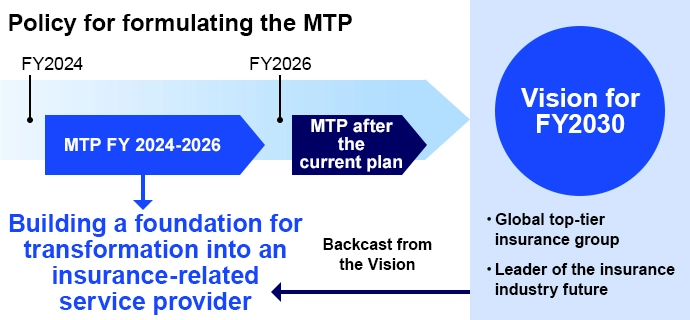
The medium-term management plan, which started in FY2024, was developed in recognition of the challenges faced up to the previous medium-term management plan and changes in the external environment. Through the plan, we aim to become a global top-tier insurance group and a leader shaping the future of the Japanese insurance industry by FY2030. The plan was formulated by backcasting the necessary actions to be taken over the three years to reach these goals. In addition, we will realize the Group's Purpose through working on the Core Materiality areas that our group has set as priority issues.
Vision for FY2030
- Global top-tier insurance group
- Leader of the insurance industry future
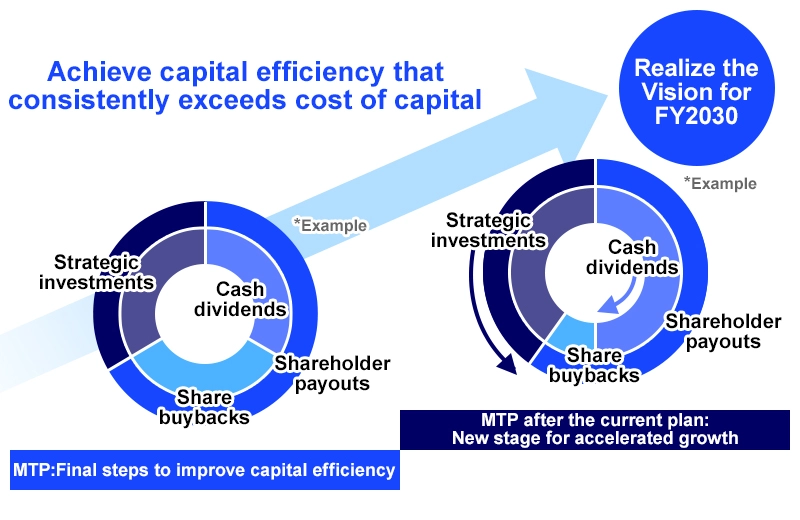
To realize our vision for 2030, we aim to achieve capital efficiency that consistently exceeds the cost of capital by continuing to reduce market risk during the current MTP, and then gradually reduce share buybacks while raising the dividend payout ratio and shifting to investments for growth to accelerate the expansion of profit scale and the enhancement of corporate value.
Medium-Term Management Plan
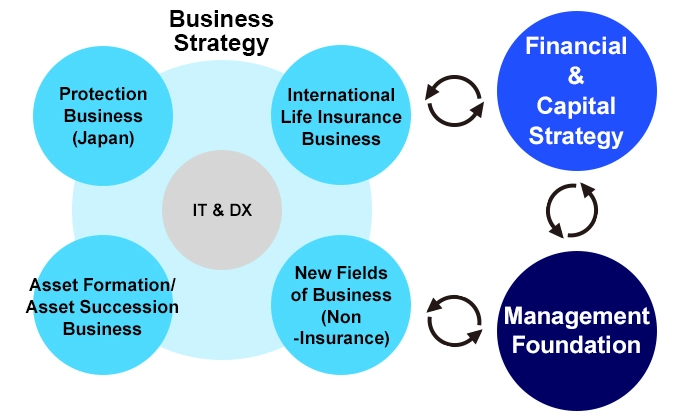
Achieve the vision for FY2026 by organically cycling through the five business strategies, financial & capital strategy, and management foundation.
- Achieving capital efficiency that consistently exceeds the cost of capital
- Building a foundation for transformation into an insurance-related service provider
- Group adj. profit of ¥560bn
- Achieving to double the market cap from ¥3tn
(as of the beginning of FY2023)
Business Strategy
Insurance Business (Japan)

- Recover VNB to pre-COVID level during the MTP period
- Complete the reform of the sales rep channel
- Enhance productivity and efficiency
International Life Insurance Business

- Enhance capital efficiency and profit contribution of the existing subsidiaries
- Dive into new market with high growth potential
- Explore and expanding to adjacent areas
Asset Management Business

- Group-wide asset management strategy
- Strengthen investment capabilities in alternative area, etc.
New Fields of Business

- Steadily executing PMI process on Benefit One
- Expansion of non-insurance area within the strategic investment budget
IT & DX

- Establish offshore development bases
- Infrastructure optimization through joint Group procurement
- In-house DX talent development
Financial & Capital Strategy

- Further reduction in interest rate and equity risks relative to EEV (Equity reduction by ¥1.2tn at DL)
- Soundness under the new ESR standard
- Prioritizing shareholder payouts (Increase in dividend payout ratio to 40% / Share buybacks ¥100bn)
- Interim dividend payment
Management Foundation

- Appointing Group Heads and expanding CxO positions
- Stock-based compensation, Job-based systems at HD
- Enhancing employee satisfaction
- Hiring and educating specialized talents
KPI Targets
Financial Indicators
| KPIs | FY2026 | FY2030 |
|---|---|---|
| RoEV | ca. 8% in the medium-to long term | |
| VNB | FY2026: ¥188.0bn | - |
| Adjusted ROE | 10% →Over 12% | Stably exceeds ca. 10% →Over 15% |
| Adjusted Profit | ¥450bn →¥560bn ~ | ¥600bn →Aim for ¥700bn |
| Cost of Capital | 8% | Maintain a stable rate of 8% or less |
| Relative TSR (vs 14 peers) | Relative advantage | |
| Economic Solvency Ratio | ≥170% | - |
We updated the targets for “Adjusted ROE” and “Adjusted Profit” compared to those set during the formulation of the medium-term plan
Non- Financial Indicators
| KPIs | FY2026 | FY2030 |
|---|---|---|
| Number of Customers | Domestic ca.37.50m ppl Overseas ca.45.00m ppl | - |
| ESG Composite Indices | Industry-leading evaluation scores in Japan | - |