
Risk Factors
The following is an unofficial translation of the risk factors included in our securities reports for the year ended March 31, 2026 submitted to the Kanto Local Finance Bureau in Japan. The information included in these risk factors, including any forward-looking statements, is as of June 16, 2026, the date of submission of our securities report (available in Japanese only).
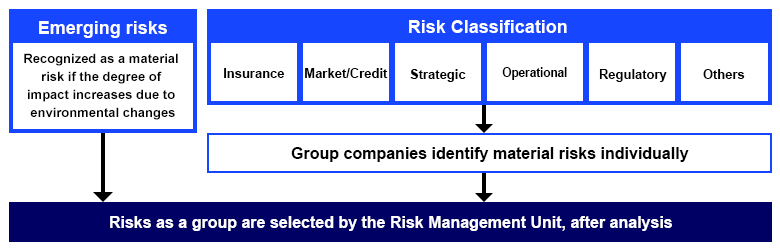
In identifying material risks, the Company evaluates the impact and possibilties of each risk on a scale of 1 to 4, based on the results of material risks identified by each group company. Using a heat map, important risks are identified as group-based material risks and reviewed annually. In addition, “emerging risks” are also identified every fiscal year as risks that are not currently material but are expected to emerge. Risks are taken into account for business planning and are managed appropriately from the time any evidence is recognized.
- <Group Material Risks and Selection Process>
- (1) Market, Credit and Liquidity Risks
- (2) Insurance Risk
- (3) Risks related to operational technology and cybersecurity
- (4) Violations of laws, misconduct, corporate culture
- (5) Pandemics and major disasters
- (6) Risks Related to Strategy
- (7) Other Risks
- (8) Risks other than “Material risks”
<Group Material Risks and Selection Process>
| Material Risks | Items set forth as “Risk Factors” | |
|---|---|---|
| Market, Credit and Liquidity |
etc. |
|
| Insurance |
etc. |
|
| Operational |
etc. |
|
| Violations of laws, misconduct, corporate culture |
etc. |
|
| Pandemic and major disasters |
etc. |
|
| Strategy-related Risks |
etc. |
|
| Others |
etc. |
|
In identifying material risks, the Company evaluates the impact*1 and possibilities of each risk on a scale of 1 to 4, based on the results of material risks identified by each group company. Using a heat map, important risks are identified as group-based material risks and reviewed annually. In addition, “emerging risks”*2 are also identified every fiscal year as risks that are not currently material but are expected to emerge. Risks are taken into account for business planning and are managed appropriately from the time any evidence is recognized.
- *1 Impact is assessed by taking into account factors such as the amount of economic loss and reputational impact, including impacts on sales, management responsibility, and share price.
- *2 Risks that are expected to newly emerge due to changes in the business environment and other factors.
The Company regularly reports the status of these “Material risks” to the Executive Management Board and the Board of Directors and strives to avoid these risks and takes appropriate countermeasures when such risks realize. In addition to material risks, the Group recognizes other risks that may have a significant impact on investor judgment.
(1) Market, Credit and Liquidity Risks
1) Deterioration in global financial markets and economy
The environment surrounding the Japanese economy remains highly uncertain. Since fiscal 2024, the Bank of Japan has raised interest rates several times, and long-term interest rates have generally been on an upward trend.
In addition, continued vigilance is required with respect to heightened volatility arising from instability in the international situation, including the ongoing invasion of Ukraine by Russia and developments in geopolitical risks in the Middle East. Looking ahead, the monetary policy stance of central banks in various countries, the impact of geopolitical risks, and other factors are expected to continue to have a significant effect on the global economy and financial markets, and uncertainty over the outlook remains.
If the global economic and financial market outlook becomes even more uncertain, financial and capital markets may face further instability, leading to falling asset prices and deteriorating market performance. In the event of serious financial instability, economic activity in major economies could be severely affected, and therefore, continued caution is required.
Although the Group regularly assesses risk tolerance through stress tests, etc., and takes prompt action to reduce risk if there are concerns regarding the financial soundness of the Group, in such cases, economic conditions deteriorate, the demand for our insurance and annuity products could be adversely affected and our surrender and lapse rates for individual insurance products could increase. Low interest yields and any declines in stock prices could also have a negative impact on our net investment income, financial conditions and results of operations.
To ensure financial soundness, the Company's basic policy is to maintain an economic value-based solvency ratio (hereinafter referred to as “ESR”) of 170% or above. As of March 31, 2026, the internal ESR stood at 220%, which we consider to be a sufficient level.
Daiichi Life Insurance Company, Limited (hereinafter referred to as “Daiichi Life”) has been continuously working to reduce market risks, including interest rate and equity risks. Under the current medium-term management plan, we have incorporated plans to accelerate the pace of reducing equity risk and are strengthening initiatives aimed at building a financial structure that is less susceptible to fluctuations in financial markets.
2) Change in the value of equity securities
Global financial markets, including Japanese equity markets may be volatile due to the global economic and financial conditions. Any declines in stock prices due to the economic crisis and uncertainty about the prospects for recovery in major economies could have a significant adverse impact on our net investment income, net assets, solvency margin ratio and our financial conditions through losses on valuation of securities, losses on sale of securities and reduced unrealized gains on securities and decrease in gains on sale of securities.
The amount of net unrealized gains on securities available for sale affects our net assets, our total solvency margin and our solvency margin ratio. In order to prepare for the risk of declines in stock prices caused by volatile market conditions and worsening economic conditions, we continuously pay attention to fluctuations in the market and also use derivative instruments to hedge market risks. If the domestic and international economic environment and stock markets continue to worsen, further losses in the future could have a material adverse impact on our financial condition and results of operations.
3) Change in interest rates
The Company conducts asset liability management (Asset Liability Management, hereinafter referred to as “ALM”) for the purpose of appropriately managing investment assets corresponding to liabilities arising from the underwriting of insurance policies, while taking into account the long-term balance between assets and liabilities, securing stable earnings, and limiting the impact on financial soundness, including ESR. However, in the event of significant changes in the market environment, such as sharp fluctuations in interest rates, the financial condition and results of operations of the Company could be materially and adversely affected. In addition, if medium- to long-term interest rates remain at significantly low levels for an extended period, it may become difficult to secure profitability, and savings-type products that are forced to be discontinued may continue to arise.
Daiichi Life is continuing its efforts to match the duration (remaining period) of assets and liabilities based on the ALM approach. During periods of declining interest rates, its average yield on investments declines because maturing investments, as well as bonds and loans that are redeemed or prepaid to take advantage of the lower interest rate environment, are replaced with new investments that provide lower yields. Such lower interest rates reduce yields on its investment portfolio while insurance premiums remain generally unchanged on outstanding policies. As a result, its profitability and long-term ability to meet policy commitments can be materially and adversely affected. In such a case, it could not secure planned profits and the average yield on its investment portfolio could be lower than the assumed rates of return used to set insurance premiums on existing policies, also referred to as “negative spread.”
Conversely, in a rising interest rate environment, higher investment yields may improve the earnings capacity of the asset management portfolio. At the same time, however, policy surrenders may increase as policyholders seek investment alternatives with higher returns. In addition, when interest rates rise, the prices of bonds and other securities decline, and deterioration in unrealized gains and losses has a negative impact on net assets. The Company Group addresses interest rate rise risk by actively utilizing policy-reserve-matching bonds, which may be measured at book value for accounting purposes subject to certain duration-matching requirements, thereby mitigating such impact. However, if interest rates rise significantly within a short period of time, or if surrenders increase sharply as a result, the financial condition and profitability of the Company Group could be materially affected.
In addition, Daiichi Frontier Life Insurance Co., Ltd. conducts ALM in order to appropriately manage investment assets corresponding to liabilities arising from the underwriting of insurance policies. Although the impact of interest rate fluctuations on ESR is expected to remain limited, differences in accounting treatment between the valuation of assets and liabilities associated with interest rate fluctuations may affect the Company Group's net assets and solvency margin, among other items. The Company takes measures to mitigate such impact, including the use of reinsurance.
4) Foreign Exchange Rate Fluctuation Risk
Our investment securities include non-yen-denominated securities. The non-yen-denominated securities consist primarily of foreign bonds (principally foreign government and agency bonds and foreign corporate bonds), foreign stocks and securitized instruments. Changes in market value of these securities, excluding those owned in the separate account or used to hedge foreign exchange risk of foreign-currency-denominated liabilities, would have an effect on our results.
While we hedge our foreign currency exposure with respect to a portion of our foreign bond holdings, a significant exchange loss could have a material adverse impact on our financial conditions and profitability.
In addition, the Group expects its foreign currency-denominated businesses, including overseas businesses, to continue to expand. As a result, fluctuations in foreign exchange rates could affect the financial condition and results of operations of the Group.
5) Investment portfolio exposes us to a number of other risks
Generating stable investment income is important to our operations and we invest in a variety of asset classes, including Japanese government and corporate bonds, foreign government and corporate bonds, domestic stocks, foreign stocks, loans, real estate and alternative investments. While we strive to minimize risks, our investment portfolio exposes us to a variety of other risks that we may be unable to avoid, as summarized below.
a) Credit risk
If the creditworthiness of issuers of bonds held by the Group deteriorates due to factors such as downgrades in their credit ratings, the market prices of such bonds may decline. In addition, such issuers may default on their obligations, including failure to make principal or interest payments. As a result, the Group may recognize valuation losses on securities, or gains and losses on sales of securities and unrealized gains and losses may deteriorate, which could adversely affect the financial condition and results of operations of the Group.
We also face counterparty risk with respect to the derivative instruments that we use to hedge market risks, such as interest rate swaps, foreign exchange forward contracts and stock index futures. Any failure by a counterparty to honor the terms of its derivatives contracts with us could lead to losses on valuation of securities and other losses or losses on sales of securities and reduced gains, which would have an adverse effect on our results of operations and financial condition.
In addition, with respect to loans, we are exposed to the risk that the financial position and the credit quality of our borrowers will erode, which could lead to increased credit costs in our loan portfolio. We provide for an allowance for possible loan losses based on evaluations and estimates regarding borrowers. However, actual losses on loans could exceed the amount of the allowance or we could be required to increase allowance amounts in the event of failures or a deterioration of the credit quality of borrowers as a result of adverse conditions in the domestic or global economy, specific industry issues or other causes.
We have significant exposure to major major financial institutions, the majority of which is in the form of subordinated debt. Generally, the value of such instruments is more sensitive to changes in the credit profile of the relevant bank issuer than the value of its senior debt instruments. Adverse changes in the creditworthiness and financial performance of Japanese banks could lead to losses on valuation of securities, increases in our allowance, and other losses or reduced gains, which would have an adverse effect on our results of operations and financial condition.
b) Real estate investment risk
We own domestic real estate for investment and business purposes. In the event an economic downturn resulted in a downward trend in real estate prices, rent and occupancy rates in Japan, our real estate-related income may decrease and our financial condition and results of operations could be adversely affected as a result.
6) Liquidity risk
Many of the products we offer allow policyholders to make policy withdrawals of a portion of the amount of accumulated premiums and to surrender their policies in return for the payment of a predetermined amount.
We manage our liabilities and our investment portfolios to provide and maintain sufficient liquidity to meet anticipated withdrawal and surrender demands, payments of policy benefits and requests to pledge collateral in relation to derivative contracts with financial and other institutions and have also entered into overdraft facilities to increase our liquidity. A certain portion of our assets, however, such as real estate, loans and privately placed securities, are generally illiquid. If we are required to pay significant amounts of cash on short notice, for example due to unanticipated withdrawal or surrender activity or a catastrophic event such as a pandemic, we could exhaust our liquid assets and overdraft facilities and be forced to liquidate other assets, possibly on unfavorable terms. In addition, turmoil in financial markets could lead to a liquidity crisis in which we are unable to dispose of our otherwise liquid assets on favorable terms or at all. If we are forced to dispose of assets on unfavorable terms or are unable to dispose of assets, it could have an adverse effect on our financial condition and results of operations.
(2) Insurance Risk
1) Difference between future claims and benefits and the actuarial assumptions used in pricing
Our earnings depend significantly on the deviation of the basic rate used to set premiums and determine the amount of policy reserves from the actual payment of claims and benefits. Assumptions include future mortality rates, investment returns and expenses related to our business. Actual mortality rates that are higher, investment returns that are lower or expenses that exceed those projected could have a material adverse effect on our financial condition and results of operations. Any revisions to the standard mortality table or the standard prospective yield would affect the determination of actuarial assumptions, and as a result, they would also affect our financial condition and results of operations. The assumptions used in pricing products that insure non-traditional risks, including “third sector” insurance products (a term used in Japan to refer to products such as medical insurance, cancer insurance and nursing care insurance products) with respect to which we have increased our sales efforts in recent years, involve an added degree of uncertainty, as they are often based on limited experience when compared to assumptions used for life insurance and annuity products covering traditional risks.
We re-estimate our policy reserves periodically and, as necessary, record changes in our policy reserves as expenses or revenues. To the extent that actual claims results are less favorable than the assumptions originally used, or if changing circumstances require us to modify our underlying assumptions, we could be required to increase our policy reserves. Such an increase, if significant, could have a material adverse effect on our financial condition and results of operations.
Some of our yen-denominated and foreign-currency-denominated fixed products have a Market Value Adjustment (MVA) function: when the interest rates decrease, we are required to make insurance reserves, and in contrast, when the interest rates increase, we reverse such reserves. Therefore, our earnings may fluctuate depending on interest rates movements. In addition, some our variable annuity products feature guaranteed minimum benefits. For guaranteed products, we are required to re-estimate our policy reserves and to make additional provisions for any shortfall that increases our expenses. In the event that we are required to make significant additional provisions, this could have an adverse effect on our financial condition and results of operations. We attempt to hedge our obligations with respect to guaranteed products through reinsurance contracts etc. However, there can be no assurance these hedging efforts will be successful and they could have a material adverse effect on our financial condition and operating results.
2) Development of medical technology and changes in healthcare policy
In recent years, due to changes in population composition and disease diagnosis, medical care has shifted its focus not only to disease treatment, but also to disease morbidity prediction and prevention. In addition to medical professionals, various health-related businesses such as biotechnology, pharmaceuticals, and healthcare have entered the medical field, and the boundary between illness and health is becoming blurred. These changes have made it possible to diagnose and treat diseases at an early stage. However, further technological development progresses may identify future disease risks, and high-risk customers will actively take out high-priced insurance. There is a possibility that insurance payments will increase significantly due to the increased risk of adverse-selection enrollment, the discovery of diseases that were not previously discovered, and the expansion of disease standards.
Furthermore, in addition to advances in medical technology, there is a risk that the incidence of claims may fluctuate beyond the assumptions used in setting premium rates due to changes in healthcare policies and systems, such as revisions to requirements for insurance coverage and changes to the High-Cost Medical Expense Benefit System.
Based on newly developed insurance products and the coverage of in-force policies, the Group monitors trends in medical technology as a whole and healthcare policy in order to prepare for these risks. The Group also evaluates the accuracy and degree of dissemination of medical technologies with a view to several years into the future, and analyzes their potential impact on the underwriting and payment of life insurance claims.
In addition, with the development of medical technology, it will be possible for insurance companies to underwrite insurance in subdivided risks, but the authority and scope of utilization of personal health data are not generally defined, and customers If you use it for insurance underwriting beyond your expectations, the Group's credibility may be significantly damaged and may incur losses.
3) Re-insurance transactions
We utilize re-insurance contracts to reduce risks related to insurance reserves, etc. However, there can be no assurance we will be able to obtain such re-insurance transactions on favorable terms, or at all, in the future. In addition, we face counterparty risk with respect to our re-insurance contracts. These factors could have an adverse effect on our financial condition and operating results.
(3) Risks related to operational technology and cybersecurity
1) Cyber attacks and system failures
To stably support the Group's global management and achieve the sustainable provision of value to customers around the world, the Group has established the “Group IT Governance Basic Policy” and is promoting the development of a Group IT governance framework based on COBIT *3.
In addition, “Group IT Governance Basic Policy” is set forth to share the direction of the IT governance system based on COBIT5 within the group. Based on the promotion of IT governance, we aim to utilize IT to contribute to the global business by creating synergies with domestic and overseas group companies by exchanging opinions and sharing information on various IT initiatives. In addition, once a year, we hold a conference that brings together IT managers of domestic and overseas group life insurance companies to discuss group-wide initiatives considering the business characteristics of each group company. We rely heavily on information technology systems, including those of third-party service providers, in conducting our business. We rely on these systems to manage customer policies, invest our assets, record and maintain statistics and personal information of our customers and in other areas of our operations. As we expand our operations and product offerings, our information technology systems could potentially require significant additional investments.
In addition, the Group's information systems may become inoperable, or information may be altered, lost, or otherwise affected, due to factors such as accidents, fires, natural disasters, power outages, concentration of access, human error, acts of sabotage, employee misconduct, software or hardware bugs or malfunctions, unauthorized external access, cyberattacks such as ransomware, or failures of facilities, software, or networks. Such events may interrupt services provided by the Group to customers, payments of insurance claims and benefits, collection of insurance premiums, asset management operations, and other business operations, or may result in errors in information disseminated by the Group. If risks related to cyberattacks or system failures materialize, they may lead to other serious consequences, including damage to the Group's reputation, customer dissatisfaction, and a decline in customer trust. They may also result in an increase in surrenders of in-force policies, a decrease in sales of new policies, or administrative sanctions. As a result, the business development and results of operations of the Group could be adversely affected.
- *3 COBIT: A framework advocated by the Information Systems Audit and Control Association and the IT Governance Institute in the United States for measuring the maturity level of IT governance.
2) Misappropriation of information
We make extensive use of online services and centralized data processing, including those provided by external contractors as well as our own systems. Therefore, strict management of confidential and personal information is important to the Group's business. However, there is no guarantee that there will be no risk of information leaks from the information systems of the Group or its outsourcing partners due to unauthorized external access, or information leaks due to loss of information by Group employees during their activities outside the company. The unauthorized use of such leaked information may cause inconvenience to our customers and may result in our Group being sued for damages, which may have a significant negative impact on our Group's financial position and business performance.
3) Tightening administrative systems and inadequate control due to environment change
The Group is striving to build an administrative structure at each company in order to promptly respond to customer cancellations and claims for insurance benefits and claims, etc., and to ensure the smooth execution of business. At Daiichi Life, due to a sharp increase in claims for insurance benefits and other payments following the spread of the COVID-19, we have taken measures such as strengthening the claims payment department by temporarily increasing the number of staff. In the event of a similar spread of infectious diseases (pandemic) in the future, there is a possibility that the administrative structure will be tightened again. In the event that existing administrative systems are unable to respond to changes in the economic or regulatory environment, expansion of business scale or business domain, outbreak of infectious diseases, or other changes in the environment, or if the establishment of internal controls and other systems does not keep pace, the Group's reputation may be damaged, to the detriment of customers, and the Group's financial position and business performance may be adversely affected.
(4) Violations of laws, misconduct, corporate culture
1) Misconduct
Sales representatives, administrative personnel, sales agents, and outside contractors may conduct fraudulent, illegal, or inappropriate activities, illegal or inappropriate sales activities that are not customer-oriented, leakage or inappropriate use of personal information, and identity theft. Although the Group has taken measures to prevent and detect such acts, failure to eliminate these fraudulent, illegal, and inappropriate acts could significantly damage the reputation of the Group and could lead to serious legal liability. As a result, the Group's business development and performance may be adversely affected.
Several cases of money fraud by former employees were revealed between 2020 and 2023 at Daiichi Life.
In response to this, Daiichi Life had implemented a comprehensive check of its individual insurance and personal pension insurance customers to see if they have been victims of any money fraud cases, and has also developed administrative procedures to prohibit its employees from directly receiving money from customers in the handling of Daiichi Life's products. In addition, we are developing and implementing systems and measures to eliminate misconduct related to money transaction. In response to these incidents, Daiichi Life has undertaken a thorough reform of its corporate culture and has revised its business policies accordingly. In the event that other financial fraud cases are uncovered in the future, the social credibility of Daiichi Life and the Group may be further damaged, which may affect business operations, and additional revisions of business policies may be necessary, which may affect the Group's business operations, performance, and financial position. In such cases, the Group's business operations, performance, and financial position may be affected.
In August 2024, it was discovered that an employee seconded from the Group to an insurance agency had leaked personal information of customers of the insurance agency to the Group's insurance company. In September 2025, it was also discovered that an employee seconded from the Group to an insurance agency had obtained internal information of the insurance agency without the consent of the insurance agency. Although these acts were intended to enable the Group to understand its performance at the insurance agency and for other purposes, such inappropriate acquisition of information is unacceptable, and the Group is taking measures to prevent recurrence. If similar incidents occur in the future, or if inappropriate use of the information obtained is identified, this could lead to further deterioration in the reputation of Daiichi Life and the Group, and the Group may be held seriously legally liable. As a result, the Group's business operations and results of operations could be adversely affected.
There is also a possibility that illegal or inappropriate actions by outside parties may occur, such as fraudulent use of insurance policies or pretending to be someone else when signing insurance policies. Some persons deal with the Group under the pretense of being antisocial forces. The Group has taken measures to prevent and detect such fraudulent activities, however, failure to eliminate such fraudulent or illegal activities or dealings with antisocial forces could significantly damage the reputation of the Group and could result in serious legal liability. As a result, the Group's business development and performance may be adversely affected.
2) Abuse of human rights
We recognize that our business activities may have an impact on human rights. In the event that abuses of human rights occur in our Group's businesses, including our supply chain, it could lead to reputational risks such as a non-purchase campaign or SNS fire, legal risks such as litigation or administrative penalties, risks such as strikes or human resource outflows, and financial risks such as stock price declines. In addition, if serious abuse of human rights are discovered in a country in which our group operates, we may be forced to withdraw from the country. As a result, our Group's business development and results of operations may be adversely affected.
The Group has established the Daiichi Life Group Code of Conduct as the most fundamental guideline for all officers and employees to think and act on a principles-based approach. The Code of Conduct sets forth “Respect for Human Rights” as one of the actions that we should take.
In addition, the Group has established the Human Rights Policy of Daiichi Life Group and is promoting initiatives for human rights due diligence based on the Human Rights Policy. Specifically, the Group promotes initiatives to respect human rights in line with the United Nations Guiding Principles on Business and Human Rights by implementing the following: (i) Formulation of Policies for Respecting Human Rights; (ii) Identification of Human Rights Risks and Assessment of Their Impact; (iii) Initiatives to Mitigate Human Rights Risks; (iv) Review and Evaluation of Initiatives; (v) Disclosure of Initiatives and Reflection of Feedback; and (vi) Initiatives Toward Remediation.
(5) Pandemics and major disasters
1) Catastrophes
We are exposed to the risk of unpredictable liabilities for insurance claim payments in the event of catastrophic mortality in Japan due to catastrophic events, such as earthquakes, tsunamis, terror attacks, disputes, wars or a pandemic, such as avian or swine flu, and other more localized disasters affecting densely populated areas in Japan. Although we maintain a contingency reserve consistent with industry practice and accounting standards, there can be no assurance that such reserve will be adequate to cover actual claim liabilities. In addition, physical damage and other effects of such catastrophes could result in significant disruptions to our business operations.
Furthermore, the operations and information systems in Japan, where our group mainly operates, are concentrated in the Tokyo metropolitan area, as are our external contractors and business partners. Therefore, an earthquake or other disaster that damages the Tokyo metropolitan area could significantly disrupt our group's business operations. In the event of an earthquake or other disaster, the Group, its outsourcing partners, and business partners may not be able to resume operations immediately, which may adversely affect the Group's business development and earnings.
2) Pandemics
The Group is exposed to the risk of unpredictable insurance benefit payments in the event of a pandemic (COVID-19, bird flu and influenza) that inflicts a large number of fatalities. The Group maintains contingency reserves in accordance with industry practices/accounting standards and regularly assesses risk resistance by means of stress tests, etc. In the event of a situation, which may include a pandemic or financial turmoil, that greatly exceeds the assumptions of a stress scenario, reserves may not be adequate to cover actual insurance payment obligations. This may adversely affect the financial condition and business performance of the Group.
3) Climate change and loss of natural capital and biodiversity
The Paris Agreement, which entered into force in 2016, has positioned the response to climate change as a common long-term global objective, and has had a significant impact on the policies and economic activities of countries, as well as on the roles of companies and financial institutions. For the Group, which operates insurance services globally, climate change is recognized as an important management issue that could have a significant impact on the lives and health of customers, corporate activities, the sustainability of society, and other matters.
From the perspective of strengthening management resilience through the assessment of risks and opportunities arising from climate change, and emphasizing dialogue with stakeholders through information disclosure, the Group expressed its support for the TCFD Recommendations in September 2018. In addition, Daiichi Life joined the Net-Zero Asset Owner Alliance*4 in the fiscal year ended March 31, 2021, becoming the first company in Japan to do so, and announced its commitment to achieving net-zero greenhouse gas emissions from its investment portfolio by 2050. With respect to RE100 (Renewable Energy 100%)*5, Daiichi Life also achieved its target one year ahead of schedule in the fiscal year ended March 31, 2023, and was certified as an RE100-achieving company*6.
The Group also recognizes nature-related issues, which are regarded as one of the important environmental issues alongside climate change, as an important management issue, since nature forms the foundation of all business activities. Accordingly, in October 2022, the Group participated in the TNFD Forum, which was established to support discussions by the Taskforce on Nature-related Financial Disclosures (TNFD) and to assist in the development of its framework. In December 2023, the Group registered as a TNFD Adopter*7, as an adopter of the disclosure recommendations published by the TNFD in September 2023 (the “TNFD Recommendations”).
Recognizing that “climate change” and “nature” are not independent risks, but are interrelated and mutually influential, the Group addresses them in an integrated manner, including in risk assessments.
Physical risks, transition risks, including policy and regulatory risks, technology risks, market risks and reputation risks, and systemic risks related to nature and climate change may adversely affect the results of operations of the Group. Physical risks may include an increase in insurance claims and benefit payments due to an increase in heatstroke associated with global warming and infectious diseases associated with pollution, the intensification of disasters caused by nature loss, an increase in insurance claims and benefit payments due to more frequent flood damage caused by typhoons and other events, and a decline in asset values or an increase in allowances due to deterioration in the business performance of investees and borrowers.
Transition risks may include a decline in the value of investments in and loans to companies that have insufficient responses to nature conservation, impairment of assets due to the introduction of carbon taxes and changes in market and social environments, a decline in the value of investments in and loans to companies that have insufficient responses to environmental changes, such as the development of new technologies and changes in consumer behavior, and the risk of deterioration in the Group's reputation due to insufficient responses to nature and climate change.
Systemic risks may include the risk that the loss of nature, which forms the foundation of all business activities, could affect the overall economy and impair the value of the Group's assets.
- *4An international initiative of institutional investors established in 2019, which aims to transition investment portfolios to net-zero greenhouse gas emissions by 2050.
- *5An international initiative that aims to procure 100% of the electricity consumed in business activities from renewable energy sources.
- *6Based on data from the RE100 Annual Disclosure Report 2023.
- *7An organization that has expressed its intention to make disclosures based on the TNFD Recommendations in either the fiscal year ended March 31, 2025 or the fiscal year ending March 31, 2026.
(6) Risks Related to Strategy
1) Risks related to acquisition and investment strategies
The Group positions acquisitions and investments in Japan and overseas as one of its important strategic measures to achieve sustainable growth. However, due to factors such as those described below, the Group may not be able to achieve the strategic effects it intends. First, suitable acquisition or investment targets may not always be available. Even if such targets are available, the Group may not be able to reach an agreement on terms acceptable to the Group. In addition, transactions may not be completed due to factors such as the need to secure acquisition funding, obtain required approvals and licenses, or comply with laws, regulations, and other restrictions. Furthermore, even after completing acquisitions or investments, the Group may not be able to realize the synergies or earnings contributions it expects due to the following risks:
- the risk that the business operations, products, services, and human resources of acquired companies or investees cannot be smoothly integrated with the Group's business operations and corporate culture;
- the risk that expected synergies between the businesses of acquired companies or investees and the Group's existing businesses are not realized;
- the risk that demand for the products and services of acquired companies or investees declines more than expected;
- the risk that the Group is unable to sufficiently extend its risk management, internal control, and reporting frameworks to acquired companies or investees, resulting in governance issues; and
- the risk that the value of target companies declines after acquisition, requiring impairment losses to be recognized.
As a result, if the Group's acquisition and investment strategies do not produce the expected results, the financial condition and results of operations of the Group could be adversely affected.
2) International operations and continuing overseas expansion
The Group is actively developing insurance businesses overseas in order to secure revenue bases outside Japan. In particular, in its overseas life insurance business, the Group is pursuing a well-balanced business expansion across markets at different stages of development, including stable markets in developed countries such as North America and Oceania, growth markets such as Vietnam and India in the Asia-Pacific region, and early-stage emerging markets where long-term expansion is expected. In addition, in line with the expansion of the regions in which it operates, the Group has established regional headquarters in North America and the Asia-Pacific region and is working to strengthen its management control and support systems. The Group strives to enhance the value of its insurance businesses in each country in which it operates. However, the penetration rate of life insurance products may not increase to the level expected by the Group or to the level seen in mature markets. As a result, the Group's business development, financial condition and results of operations could be adversely affected.
Our international operations and continuing overseas expansion expose us to a number of risks, including:
- political and social instability;
- fluctuations in foreign currency exchange rates;
- introduction and revision of unfavorable tax regulations;
- unexpected legal or regulatory changes;
- limited understanding of customer needs, market conditions and local regulations;
- difficulties in recruiting and retaining personnel and managing international operations; and
- competition with additional multinational firms.
Although we intend to continue to expand our international operations, because of the risks associated with such expansion, including the risks described above, there is no assurance that our overseas expansion will be successful. In Myanmar, considering the situation in the country after February 2021, we temporarily suspended operations in Myanmar and resumed them in stages.
We may suffer impairment losses on our investments in overseas companies and could withdraw from markets where we do not achieve our intended goals.
3) Delay in Digital Transformation (DX)
Digital transformation (DX), which leverages technology and information to automate and streamline operations while providing superior customer experience value (CX), is considered a source of differentiation and competitiveness for companies. Recognizing this, the group positions DX as a critical strategy and promotes DX initiatives such as “frequent, bidirectional digital communication with customers,” “digital support for sales channels centered around life planning designers,” and “development of new products and services using data and AI.”
Should the group's efforts in these areas lag behind those of other companies, or should there be significant innovations due to the emergence of new technologies or new entrants that the group is unable to respond to, it may result in a decline in our competitiveness in acquiring new contracts and supporting existing ones. This could potentially have an adverse effect on our performance over the long term.
4) Risks Related to the Use of AI
AI technology has developed and spread rapidly in recent years, bringing about significant changes in the business environment, including the implementation of AI in business and its use for business transformation and operational efficiency in various industries. If the Group is unable to respond appropriately to such changes in the environment and its initiatives for the use of AI lag behind those of other companies, the Group's revenues may be adversely affected due to a decline in competitiveness, resulting in a decrease in new policies, deterioration in persistency rates, delays in improving operational efficiency, and other factors. If the Group is unable to maintain and demonstrate its advantages in its business foundations, including the sales representative's channel, this may adversely affect the results of operations in the future.
In addition, the Group is developing systems such as governance and management rules for the use of AI. However, if AI is used inappropriately by group companies or departments, violations of laws and regulations or ethical issues may arise. As a result, reputational deterioration, including a decline in social reputation and trust, may lead to a decrease in new policies, outflows of existing policies and other adverse consequences.
If these risks materialize, they may adversely affect the execution of the Group's medium- to long-term growth strategy and its results of operations.
5) Risks Related to Delays in Responding to Inflation
In recent years, inflationary pressures have continued to intensify both in Japan and overseas, including increases in prices and wages, as well as rises in energy prices and various other costs, and such an environment may continue over the medium to long term. Under these circumstances, if the Group is unable to appropriately and flexibly implement business strategies, product design, premium rate setting, cost structure reforms and other measures that sufficiently take into account the progress of inflation, this may lead to a decline in competitiveness and deterioration in its profit structure due to an increase in operating expenses. If the Group is unable to absorb increases in operating expenses and personnel expenses associated with inflation, or if its response to the market environment is delayed, this may lead to a decrease in new policies and a decline in profitability. If these responses are insufficient, the execution of the Group's medium- to long-term growth strategy, results of operations and financial condition may be adversely affected.
6) Demographic Trends in Japan
Japan's total fertility rate had been on a long-term declining trend since around 1975. Although it turned upward after 2005, it has continued to decline in recent years, and the current level remains far below Japan's population replacement level. The Company develops products and formulates sales strategies based on such demographic trends. However, if the population further declines in the future and demand for life insurance decreases, the scale of the Company's domestic insurance business may shrink, which may have a material adverse effect on its financial condition and results of operations.
7) Sales are Concentrated in Individual Life Insurance Policies
A high proportion of the premium income of the Group's domestic life insurance companies is derived from individual life insurance policies, and sales of individual life insurance products are affected by various factors, including the following:
- Employment levels and household income levels in Japan
- The relative attractiveness of alternative savings products and investment products
- General perceptions regarding the financial soundness, reliability and reputation of insurance companies
- Long-term demographic trends affecting Japan's population structure, such as trends in birth rates and aging
- Customer needs regarding sales channels and products
Changes in these factors may result in a decrease in new policy sales or an increase in surrenders and lapses of existing policies in the Group's individual life insurance products, which may adversely affect the Group's financial condition and results of operations.
Although the Company's domestic insurance business is promoting the diversification and expansion of sales channels for individual life insurance products, it currently depends largely on sales representative channels and financial institutions such as banks. If, in the future, new channels grow to a scale that replaces existing channels due to changes in regulations or the environment, or if the recruitment environment for sales representatives becomes more severe and the Company is unable to secure the expected number of recruits, resulting in a significant decrease in the number of sales representatives, the Group may face challenges in maintaining its current competitiveness, profitability and market share. As a result, the Group's business development and results of operations may be adversely affected.
8) Sales of Insurance Products through Banks, Insurance Shops and Other Channels
In addition to the sales representative channel, the Group utilizes sales channels such as banks, securities companies and insurance shops to provide insurance products that respond to the diversifying needs of customers.
Daiichi Frontier Life Insurance Co., Ltd. develops and sells annuity products and other products through sales channels such as banks and securities companies. Daiichi Neo Life Insurance Co., Ltd. provides easy-to-understand and simple products and services, mainly third-sector products such as medical insurance, through bank counters, insurance shops and other channels.
The Group is promoting the diversification of sales channels and product lineups and is working to formulate strategies and provide products in response to the competitive environment. However, various risks exist, including the following:
- Risk that sales strategies may not be realized as expected
- Decrease in the number of sales due to the sale of similar products by competitors
- Increase in operating expenses due to intensified commission competition
- Intensified competition between financial institutions such as banks and securities companies and sales representatives
- Delayed responses to changes in the external environment, such as revisions to supervisory guidelines concerning insurance agencies
Furthermore, with respect to variable annuity insurance and other products, demand may decline and sales may be sluggish due to stagnation in the domestic economy and deterioration in asset management performance.
Due to these factors, the Group may be unable to maintain or strengthen its competitiveness in these channels, secure profitability, or achieve its target results of operations. As a result, there is a risk that the Group's business development, financial condition and results of operations may be adversely affected.
9) Competition in the Japanese Financial Service Industry
The Group's domestic life insurance companies face intense competition in the Japanese life insurance market from domestic life insurance companies, foreign life insurance companies, and major domestic financial institutions that have insurance subsidiaries or business alliances with major insurance companies. In particular, the competitive environment in the Japanese life insurance market has become more severe due to deregulation, a decline in demand for mortality protection-type insurance products, and intensified competition with foreign life insurance companies. Some of the Group's competitors have advantages over the Group in terms of excellent financial assets and financial strength ratings, strong brand recognition, large-scale sales and distribution networks, competitive pricing, a large customer base, high policyholder dividends, and a broad range of products and services.
Japan Post Insurance Co., Ltd. maintains a competitive advantage in the Japanese insurance market due to factors such as its large customer base, use of the nationwide post office network, and the indirect partial government ownership through Japan Post Holdings Co., Ltd. If the scope of business of Japan Post Insurance Co., Ltd. is expanded while maintaining such competitive advantages, including revisions to the upper limit on insured amounts and expansion of the types of insurance policies it is permitted to sell, the competitiveness of the Group's domestic life insurance companies may decline relatively. The Company and Japan Post Insurance Co., Ltd. have entered into a business alliance for the purpose of strengthening their business foundations and realizing sustainable enhancement of corporate value by mutually complementing and integrating their respective strengths. In addition, the Group also faces competition from various cooperatives that provide competing insurance products, such as the National Mutual Insurance Federation of Agricultural Cooperatives, the National Federation of Workers and Consumers Insurance Cooperatives, and the Japanese Consumers' Co-operative Union.
Various deregulation measures have also intensified competition in the Japanese life insurance industry. For example, numerous deregulation measures enacted between 1998 and 2007 enabled securities companies and banks to sell insurance products. Furthermore, insurance companies that utilize insurance shops, the Internet and other channels as their main sales channels have emerged. The Group believes that competition with insurance companies utilizing such diverse sales channels will further intensify in the future. In addition, further reorganization in Japan's financial industry may affect the competitive environment for the sale of life insurance products.
The Group also faces competition from local insurance companies in each overseas market.
If the Group is unable to maintain its competitiveness, such competitive pressures and other factors may lead to a decrease in the Group's new policy sales and an increase in surrenders of existing policies, which may have a material adverse effect on the Group's business and results of operations.
(7) Other Risks
1) Subject to Extensive Regulation
a) Risks Related to the Supervisory Authority of Regulatory Authorities
The Company, the Group's domestic insurance companies and domestic small-amount and short-term insurance providers are subject to broad supervision, including comprehensive regulation by the Financial Services Agency, under the Insurance Business Act and related industry regulations. In addition, the Group's overseas life insurance companies are subject to laws and regulations in the countries, states and other jurisdictions in which they conduct business, and, where deemed particularly necessary, may be subject to orders to submit reports and on-site inspections by the Financial Services Agency.
For example, the Insurance Business Act of Japan regulates the types of businesses that insurance companies may conduct and requires insurance companies and insurance holding companies to maintain certain reserves and minimum solvency margin ratios. The Insurance Business Act grants the Prime Minister broad supervisory authority over the insurance business, including the authority to revoke licenses, suspend business operations, require reports, and conduct strict on-site inspections of accounting records and other matters. In addition, if an insurance company or insurance holding company violates particularly important provisions of the Insurance Business Act or other laws and regulations, the Prime Minister may revoke the license of the insurance company or the authorization of the insurance holding company. Furthermore, if the financial condition of an insurance company deteriorates significantly and it is deemed inappropriate from the perspective of protecting policyholders and others for the insurance company to continue its insurance business, the Prime Minister may revoke the insurance company's license.
As described above, if the licenses of the Group's insurance companies or small-amount and short-term insurance providers, or the authorization of an insurance holding company, are revoked by the supervisory authorities, such companies will be unable to continue their business activities, which may have a material adverse effect on the Group's results of operations.
b) Risks Related to Solvency Margin Ratio and Other Regulations
Currently, the Company and the Group's domestic insurance companies are required under the Insurance Business Act and related industry regulations to maintain a solvency margin ratio, which is a standard for measuring the adequacy of capital, in excess of 100%, and domestic small-amount and short-term insurance providers are required to maintain the same ratio in excess of 200%. The Group's overseas insurance companies are also required to maintain financial soundness at a certain level under the regulations and other requirements of each country.
For example, if the Company or any domestic insurance company is unable to maintain its solvency margin ratio at an appropriate level, the Prime Minister may order such company to take prompt corrective action. Specifically, if the solvency margin ratio of the Company or a domestic insurance company falls below 100%, the order for corrective action by the Prime Minister will be triggered depending on the circumstances, thereby encouraging the Company or such domestic insurance company to take early steps to improve management. The details of such measures are prescribed according to the level of the solvency margin ratio and other factors. Such prompt corrective action may adversely affect the Group's business development and results of operations. In addition, these regulations were revised in March 2026, and such revision may affect the Group's business development and results of operations.
The Group's overseas insurance companies are also required to satisfy certain standards regarding capital and solvency under the laws and supervisory regulations of each country. If they fail to satisfy such standards, various measures concerning business operations may be taken by the supervisory authorities of each country.
c) Risks Related to International Regulations
The International Association of Insurance Supervisors (“IAIS”) has developed ComFrame, a common framework for the supervision of internationally active insurance groups (“IAIGs”), which was adopted in November 2019. The basic concept of the domestic solvency margin regulations revised in March 2026 is indicated to be “to apply standards to all insurance companies and all insurance holding companies based on the common specifications and basic structure of the ICS, with Japan-specific modifications to the extent deemed reasonable, and to regard such standards as the domestic implementation of the ICS for IAIGs in consolidated regulation.” The content of the revision differs significantly from the previous regulations, and changes arising from this revision and related restrictions may adversely affect the Group's business development and results of operations.
In October 2022, the FATF (Note 8) designated Myanmar as a “High-Risk Jurisdiction subject to a Call for Action,” commonly referred to as the “black list,” and requested FATF members, including Japan, to apply enhanced due diligence. As stricter verification procedures at financial institutions may give rise to risks such as delays in the execution of financial transactions, particularly those related to Myanmar, the Group will continue to closely monitor developments.
Furthermore, International Financial Reporting Standard 17 “Insurance Contracts” (“IFRS 17”), issued by the International Accounting Standards Board, evaluates insurance contracts based on economic value, and therefore fluctuations in financial markets each period may affect net assets. The Group is continuing to research and study the accounting standard for insurance contracts, IFRS 17, considering the possibility that it may affect the preparation of financial statements by insurance companies. If IFRS or standards equivalent thereto are applied to the Group's accounting standards in the future, the Group's business development and results of operations may be affected.
(Note 8) FATF stands for Financial Action Task Force. It is a multilateral framework established in response to the Economic Declaration of the Arche Summit in 1989 and is responsible for establishing and implementing international standards for measures against money laundering and other matters. The FATF identifies countries and regions with insufficient compliance with international standards and publishes “High-Risk Jurisdictions subject to a Call for Action” and other lists to monitor improvement status.
2) Future Changes in Laws and Regulations
In Japan and the overseas countries in which the Group conducts business, amendments to laws and regulations and changes in government policies concerning their enforcement, regulatory measures against the Group and insurance companies, and regulatory trends related to the expansion of the product lineup handled by the Group may affect sales of the Group's insurance products, increase compliance risks, lead to additional expenditures for strengthening and improving compliance, and cause restrictions on product development and insurance sales. These factors may adversely affect the Group's business, financial condition and results of operations.
A large number of sales representatives and sales agents are involved in the Group's business, and if regulations are amended in the future, the Group may not be able to establish systems that comply with such amendments in a timely manner.
In addition, Japan's current Income Tax Act permits all or part of the premiums paid for most insurance products provided by the Group to be deducted from income. Similarly, corporate or small and medium-sized enterprise policyholders are permitted, under certain conditions, to include all or part of the premiums for certain insurance products, such as term insurance and annuity products, as deductible expenses. Tax reforms that affect the tax treatment of premiums for the Group's insurance products may adversely affect the number of new policy sales of the Group and, consequently, its results of operations.
3) Litigations
Companies within the Group that engage in insurance business are constantly involved in litigation related to the insurance business. Although the outcome of current and future litigation cannot be predicted, depending on the outcome, the Group may incur substantial liability for damages. The Group has established systems to eliminate, to the extent possible, the possibility of being subject to litigation through measures such as the establishment of the “Group Compliance Regulations,” the establishment of the Group Compliance Committee, and monitoring by such committee of the status of compliance promotion at group companies. If substantial legal liability is imposed or significant costs are incurred in responding to litigation, the Group's reputation may deteriorate, and the Group's business, financial condition, results of operations and cash flows may be materially adversely affected.
4) Reputation Risk
If the Group's name is reported or publicly disclosed because of the discovery of inappropriate incidents or other matters, the Group's credibility may be significantly damaged and the Group may incur losses.
The Group strives to maintain and enhance trust through press releases and timely information disclosure, and endeavors to prevent risks from materializing. However, even if information that differs from the facts is disseminated by the media, policyholders, market participants and others may understand and perceive the Group based on the reported information. As a result, the Group's reputation may deteriorate, which may adversely affect the Group's business development and results of operations.
5) Risks Related to Recruitment and Employment
To achieve sustainable growth as an insurance group that conducts business globally, it is essential for the Group to acquire and retain human resources with diverse and advanced expertise. However, competition to acquire human resources has intensified, particularly for professionals such as digital human resources and actuaries. If the Group is unable to secure sufficient necessary human resources, this may have a material adverse effect on the Group's business development and results of operations.
In addition to the above human resources, it is important for Daiichi Life, which accounts for approximately 70% of the Group's adjusted profit and is the core of the domestic business, to secure and retain sales representatives. To stably secure and retain sales representatives over the long term, whose turnover rate tends to be higher than that of other job categories, Daiichi Life has implemented measures such as developing a compensation system that combines stable fixed salaries with performance-based pay linked to sales results. On the other hand, if Daiichi Life is unable to secure and retain sales representatives, this may hinder the maintenance and expansion of its sales foundation and may have a material adverse effect on the Group's results in operations.
(8) Risks other than “Material risks”
1) Risks Associated with Downgrades in the Group's Ratings
If the Group's financial soundness actually deteriorates or is perceived to have deteriorated, the Group's business development, financial condition and results of operations may be adversely affected in the form of an increase in surrenders and refunds of insurance policies, a decrease in new policy sales, an increase in expenses, and other problems related to the Group's asset management, financing and capital enhancement measures. These adverse effects may arise not only from the possibility of rating downgrades across the insurance industry, negative media coverage or rumors, and deterioration in business performance, but also from actual downgrades of the ratings of the Group companies and significant deterioration in financial soundness indicators such as ESR. In particular, if the Group's financial soundness indicators deteriorate significantly compared with those of other life insurance companies, this may have a material adverse effect on the Group's business development, financial condition and results of operations.
In addition to cases where the Group's financial soundness actually deteriorates or is perceived to have deteriorated, if capital markets or credit markets in which the Group seeks to raise funds deteriorate, the Group may be unable to strengthen its capital on favorable terms, or may be unable to strengthen its capital at all. As a result, the Group's business development, financial condition and results of operations may be adversely affected.
2) Risks Related to Relationships with Business Alliance Partners and the Performance of Business Alliance Partners
The Group enters business alliances with companies both within and outside the life insurance industry to expand its sales channels and product lineup. These alliances are intended to realize sustainable enhancement of corporate value through the expansion of sales of third-sector products, annuity products and other products, as well as the strengthening of business foundations. The Group also has affiliated companies, including joint ventures with other companies, in areas related to its business development as a group. If financial or other operational problems, inappropriate conduct, violations of laws and regulations or other issues occur at these strategic alliance partners or affiliated companies, the alliance effects initially expected by the Group may not be fully realized, and the Group's credibility and brand value may be damaged. Furthermore, if these strategic alliance partners or affiliated companies face financial or other business problems, change their strategic orientation due to industry reorganization or other factors, or determine that the Company is no longer an attractive alliance partner, they may no longer wish to maintain business alliances with the Group, or such alliances may be dissolved. If the Group is unable to continue business alliances, the Group's business development and results of operations may be adversely affected.
3) Risks Related to Risk Management
The Group's risk management policies and procedures are designed to address a wide range of risks, including insurance underwriting risk, asset management risk, liquidity risk, administrative risk and system risk. Many of the methods used to manage the Group's risk exposures are based on statistical values derived from past market trends and historical data. These methods may not necessarily predict future losses, and future losses may significantly exceed expected losses indicated by past results. Other risk management methods rely, to some extent, on the Company's evaluation of generally available information regarding markets, customers and other matters. However, such information may not always be accurate, complete or up to date, and may not always be properly evaluated. In addition, errors may occur in the Group's risk management procedures in the process of integrating information collected from numerous sources, including group companies. In general, errors or lack of effectiveness in these risk management policies and procedures may have a material adverse effect on the Group's financial condition and results of operations.
In particular, the management of administrative risk requires policies and procedures to appropriately record and verify a vast number of transactions and events. However, the Group's policies and procedures themselves may not necessarily be effective. Administrative errors by employees, business alliance partners or external contractors may cause reputational or financial damage to the Group and may also lead to administrative sanctions. As a result, the Group's financial condition and results of operations may be materially adversely affected.
4) Risks Related to Increase in Retirement Benefit Expenses
We may face additional costs relating to our employees' retirement benefit plans from changes in the market value of pension assets, a decline in returns on our pension assets or changes in the assumptions and investment returns on which the calculation of projected benefit obligations is based. We may also experience unrecognized losses on plan amendments in the future resulting from amendments to our employees' retirement benefit plans, which could potentially have an adverse effect on our financial condition and operating results.
5) Risks Related to Policy Reserve for Policyholder Dividends
Provisions for reserve for policyholder dividends in our consolidated statement of earnings are treated as expenses and decreases net income. Dai-ichi Life has the discretion to determine the provision for reserve for policyholder dividends. It considers many factors, including the competitiveness of our products, its results of operations and its solvency margin ratio, in determining the level of provisions for reserve for policyholder dividends, and it exercises discretion in order to provide an amount. As a result, there is no assurance that we may not make provisions in excess of the current reserve level in the future, which could potentially have an adverse effect on our operating results.
6) Risks Related to Impairment of Goodwill
When the Group acquires another company or business, if the expense required for the acquisition (acquisition cost) exceeds the net amount allocated to the assets received and the liabilities assumed, the excess amount shall be accounted for as goodwill. It is recognized and recorded as goodwill or securities on the consolidated balance sheet.
The Group conducts a determination every period on whether goodwill impairment losses should be recognized. If gains/losses or cash flow obtained from the asset group including goodwill continues to be negative, or if the recoverable amount of the asset group including goodwill declines significantly, or if the business environment of the asset group, including goodwill, deteriorates significantly, there is a possibility that amortization of goodwill will be recognized.
7) Risks Related to Changes in Accounting Standards for the Calculation of Policy Reserves
The Insurance Business Act and related regulations and guidelines set forth the standards under which policy reserves are calculated. Changes to such standards that would require us to increase our policy reserves could have a material adverse effect on our reported financial condition and results of operations. For example, the International Accounting Standards Board, or the IASB, which develops International Financial Reporting Standards (IFRS), is currently considering new accounting standards for insurance contracts, including current value accounting for liabilities. Current value accounting for liabilities would require us to calculate policy reserves based on the current fair value of policy obligations taking into account factors such as current interest rate levels. In anticipation of the application of current value accounting for liabilities, we make provisions for policy reserves in excess of the amount currently required under applicable standards. If higher provisions for policy reserves than those that we have made are required, this could have an adverse effect on our financial condition and results of operations.
8) Risks Related to Reduction in Deferred Tax Assets
In accordance with Japanese GAAP, the Group recognizes deferred tax assets in its consolidated balance sheet, after offsetting them against certain deferred tax liabilities, in the amount expected to have the effect of reducing future tax liabilities.
The calculation of deferred tax assets is based on various assumptions, including assumptions regarding future taxable income, and actual results may differ significantly from these assumptions. In addition, if future changes in accounting standards impose restrictions on the amount of deferred tax assets that the Group may recognize, or if the Group concludes, based on its outlook for future taxable income, that a portion of its deferred tax assets is not recoverable, deferred tax assets may be reduced.
As a result, the financial condition and results of operations of the Group could be materially and adversely affected.
In the event the corporate income tax rate is changed following tax reforms, and our effective statutory tax rate decreases in the future, our performance and embedded value would likely improve in the medium- to long-term. On the other hand, a decrease in effective statutory tax rate may require us to reverse our deferred tax assets estimated based on the corporate income tax rates in effect prior to the reform, and this could have an adverse effect on our results of operations.
9) Risks Related to the Holding Company Structure
The Company is a holding company and dividends paid to us from our subsidiaries are our main source of revenue. Under certain circumstances, these dividends are restricted by laws and regulations of Japanese and overseas governments and regulators. In addition, if our subsidiaries and affiliates are not profitable, they will not be able to pay dividends to the holding company, which could prevent dividend payout.
10) The failure of other Japanese life insurance companies could require us to increase our contributions to industry-wide policyholder protection funds and could undermine consumer confidence.
Our group domestic insurance companies, along with other life insurers in Japan, are required to support policyholders of failed life insurance companies through payments to the Life Insurance Policyholders Protection Corporation of Japan (LIPPC). The LIPPC provides funds upon acceptance and assumption by a successor life insurance company of the insurance policies of a failed life insurance company and also performs certain other specified functions. The proportion of required contributions allocated to them could increase if their income from insurance premiums and policy reserves increase relative to other life insurance companies in Japan. In the event of future failures of Japanese life insurance companies or if the legal requirements for contributing to the LIPPC change, they may be required to make additional contributions to the LIPPC and our financial condition and results of operations could be adversely affected.
The failure of other Japanese life insurance companies could also damage the reputation of the Japanese life insurance industry and undermine consumer confidence in Japanese life insurers in general, which could lead to a decrease in our sales of new policies or an increase in lapses or surrenders of existing policies.
In identifying material risks, the Group assesses the impact*1 and likelihood of occurrence of each risk on a four-point scale, based on the results of the identification of material risks at Group companies. Using a heat map, the Group identifies risks with a high level of materiality as material risks on a Group-wide basis, and reviews them annually.
In addition, the Group also identifies “emerging risks”*2 annually as risks that are not currently considered material risks but may newly emerge in the future.
By formulating business plans that take these risks into account, the Group promotes a PDCA cycle based on risk awareness and appropriately manages risks from the early warning stage.
- *1Impact is assessed by taking into account factors such as the amount of economic loss and reputational impact, including impacts on sales, management responsibility, and share price.
- *2Risks that may newly emerge due to changes in the business environment and other factors.