
Corporate Governance Structure
Enhancement of Management Control System
Conduct of Business
Board of Directors
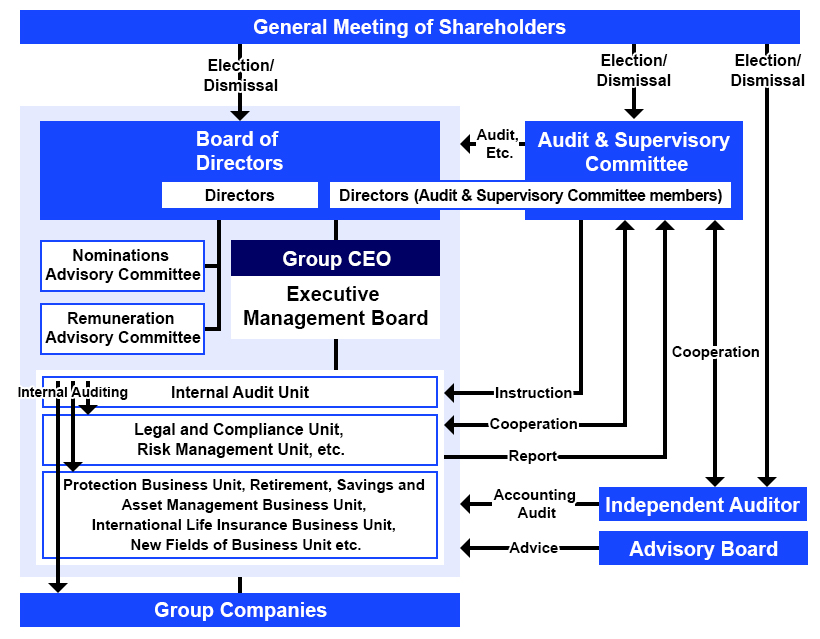
The Board of Directors of Daiichi Life Group is responsible for making important decisions on the Group’s management strategy, management plan, etc. and supervises the execution of business operations. The Board of Directors consists of inside directors with knowledge and experience necessary to perform management in an accurate, fair, and efficient manner and outside directors with the deep insight, rich experience, and independence necessary to fully demonstrate supervisory functions. The number of outside directors makes up one-third or more, in principle. In terms of the constitution of the Board of Directors, its diversity is taken into account, such as gender, nationality and so forth. Furthermore, the meeting of the Board of Directors shall be held no less than once in every three months and may also be held on an ad-hoc basis as necessary.
To improve management transparency, the Nominations Advisory Committee and the Remuneration Advisory Committee, each composed of the Chair of the Board, President, and external appointees, have been established under the Board of Directors. The Nominations Advisory Committee is responsible for assessing the qualifications of director candidates and deliberating on the appointment and dismissal of directors, and also for assessing the independence of outside directors appointed by the company based on the independence criteria. The Remuneration Advisory Committee is responsible for deliberating on the remuneration system for directors and executive officers. The composition and principal matters deliberated by each committee are disclosed in the Corporate Governance Report.
Furthermore, the Advisory Board has been established as a voluntary organization composed of corporate executives and external experts, with the aim of further strengthening and enhancing governance and increasing corporate value by obtaining extensive advice from a medium- and long-term perspective on a wide range of management issues, taking into account the external environmental changes.
| Number of directors | 15 Number of directors of the Audit & Supervisory Committee 5 (as of June 22, 2026) |
|---|---|
| Number of outside directors | 7 Number of outside directors of the Audit & Supervisory Committee 3 (as of June 22, 2026) |
| Number of board meetings | 20 (FY2025) |
Director Skill Matrix
The Company defines knowledge and experience necessary for directors as follows in order to fulfill its supervisory function as a holding company and to appropriately implement its medium term management plan.
Specifically, the Company defines 1 to 7 below as knowledge and experience required for directors of an insurance holding company based on the characteristics of the life insurance business, and 8 to 11 as knowledge and experience regarding important future business strategies and management issues based on the medium-term management plan.
A skill matrix of the Directors of the Company is as follows.
- *The relevant item is checked if a director has expertise and experience or has a background as a business manager in the respective field.
| Name | Title | ① Corporate Management | ② Global | ③ Insurance Business | ④ Finance / Asset Management | ⑤ Capital Policy / Financial Accounting | ⑥ Legal Affairs / Compliance | ⑦ Risk Management | ⑧ IT / Digital / DX | ⑨ M&A / New Business | ⑩ Sustainability | ⑪ Human Resources Management |
|---|---|---|---|---|---|---|---|---|---|---|---|---|
| Seiji Inagaki | Director, Chair of the Board |  | | | | | | | | | ||
| Tetsuya Kikuta | Representative Director, President Group Chief Executive Officer | | | | | | | | | | ||
| Hitoshi Yamaguchi | Representative Director, Senior Managing Executive Officer Group Chief Human Resources Officer | | | | | | | |||||
| Takako Kitahori | Director, Managing Executive Officer Group Chief Customer Experience Officer (Japan) | | | | ||||||||
| Toshiaki Sumino | Director | | | | | | | | | | ||
| Kiyoto Matsuda | Director | | | | | | ||||||
| Yasushi Shingai | Outside Director | | | | | | | | | | ||
| Bruce Miller | Outside Director | | | | | | | |||||
| Ichiro Ishii | Outside Director | | | | | | ||||||
| Etsuko Shakespeare | Outside Director | | | | | |||||||
| Takahiro Shibagaki | Director (Audit & Supervisory Committee Member (Full-Time)) | | | |||||||||
| Kenji Yamakoshi | Director (Audit & Supervisory Committee Member (Full-Time)) | | | | | | ||||||
| Satoshi Nagase | Outside Director (Audit & Supervisory Committee Member) | | | | | | | | ||||
| Ayako Makino | Outside Director (Audit & Supervisory Committee Member) | | | |||||||||
| Junko Ogushi | Outside Director (Audit & Supervisory Committee Member) | | | |
| Nominations Advisory Committee | Remuneration Advisory Committee | |
|---|---|---|
| Members | Yasushi Shingai (Outside Director) Bruce Miller (Outside Director) Ichiro Ishii (Outside Director) Satoshi Nagase (Outside Director (Audit & Supervisory Committee member)) Seiji Inagaki (Director, Chair of the Board) Tetsuya Kikuta (Representative Director, President) | Ichiro Ishii (Outside Director) Etsuko Shakespeare (Outside Director) Ayako Makino (Outside Director (Audit & Supervisory Committee member)) Junko Ogushi (Outside Director (Audit & Supervisory Committee member)) Seiji Inagaki (Director, Chair of the Board) Tetsuya Kikuta (Representative Director, President) |
| Number of committee meetings | 11 (FY2025) | 11 (FY2025) |
| Main deliberation agenda |
|
|
Assessment of Effectiveness of the Board of Directors
To underpin the effectiveness of decision-making by the Board of Directors, the board uses self-evaluation and other techniques to undertake an annual review of the efficiency of its meeting practices and effectiveness of its decision-making, and reports a summary of the results.
For the FY2025 evaluation, a third-party organization conducted a one-hour interview with all Directors individually, after conducting an anonymous survey of all Directors in advance. The advance survey consists of a total of 49 questions in 8 categories, which include “Overall Evaluation,” “Structure,” “Preparation in Advance, etc.” “Operation,” “Contents of Discussion” “Each Committee,” “Execution Monitoring” and “Culture.” The third-party organization evaluated that the effectiveness of the Board of Directors is generally at a high level.
An ongoing program is in place to improve the effectiveness of the Board of Directors by working through the PDCA improvement cycle, including by third-party evaluation to further improve the activities and deliberations of the Board of Directors.
Conduct of business
An executive officer system has been adopted to separate decision-making and supervision from the conduct of business and to strengthen functions. Executive officers are appointed by the Board of Directors and conduct business in accordance with the authority delegated to them by the Board of Directors. The Executive Management Board, composed of the President and Executive Officers appointed by the President, meets monthly in principle to discuss important management issues and business decisions.
Audit & Supervisory Committee
Audit & Supervisory Committee verifies and evaluates the effectiveness of Directors' execution of their duties (mainly with regards to their performance in managing group companies etc.) and carries out audit on their legitimacy and validity.
The Committee gathers necessary information to verify and evaluate the effectiveness of directors' activities by requiring reports from internal audit and internal control functions, participating in material meetings, interviewing directors and officers, and reviewing material documents.
Audit & Supervisory Committee executes supervisory roles to the Board of Directors by forming and providing opinions on directors' nomination, removal, and remuneration. In forming these opinions, the Committee reviews the appropriateness of the discussions and processes in the Nominations Advisory Committee and Remuneration Advisory Committee.
Staffs who provide administrative support for the activities of the Audit & Supervisory Committee are assigned to Office of the Audit & Supervisory Committee, and transfers and performance evaluation of these staffs are to be discussed with the members of Office of the Audit & Supervisory Committee, therefore their independence from the Board of Directors are maintained.
| Number of the Audit & Supervisory Committee members | 5 (as of June 22, 2026) |
|---|---|
| Number of the Outside Audit & Supervisory Board Members | 3 (as of June 22, 2026) |
| Number of the Audit & Supervisory Committee meetings | 30 (FY2025) |
Reasons for appointing outside directors and their activities
| Role | Name | Reasons for appointment | Activities during FY2025 |
|---|---|---|---|
| Outside director | Yasushi Shingai | In addition to his deep experience and insight gained through acting as business executive of a global company, he has rich experience and sophisticated and expert knowledge of corporate finance and mergers & acquisitions as the finance officer. He has also brought significant benefits to the Company by supervising management and advising on various matters of corporate management based on his global and objective viewpoint at the Board of Directors meetings and other occasions. The Company expects that he will continuously share his experience and expertise on oversight of management of the Group as before, and therefore proposes him as an outside director. | Attended 20 Board of Directors meetings out of all 20 meetings held |
| Outside director | Bruce Miller | He is a specialist in global politics and economy and has rich experience and deep insight into the life insurance business as a Non-Executive Director of TAL, a subsidiary of the Company. He has also brought significant benefits to the Company by supervising management and giving advice on various matters of corporate management based on his global and objective viewpoint at the Board of Directors meetings and other occasions. The Company expects that he will continuously share his experience and expertise on oversight of management of the Group as before, and therefore proposes him as an outside director. | Attended 20 Board of Directors meetings out of all 20 meetings held |
| Outside director | Ichiro Ishii | In addition to his deep experience and insight gained through acting as a business executive of a global company, he has rich experience and sophisticated and expert knowledge of M&A and post-acquisition integration processes as the officer for an overseas insurance business in a major financial institution. He has also brought significant benefits to the Company by supervising management and giving advice on various matters of corporate management based on his global and objective viewpoint at the Board of Directors meetings and other occasions.The Company expects that he will continuously share his experience and expertise on oversight of management of the Group as before, and therefore proposes him as an outside director. | Attended 20 Board of Directors meetings out of all 20 meetings held |
| Outside director | Etsuko Shakespeare | In addition to her deep experience and insight gained as a person responsible for the marketing and advertising sales divisions of global companies, she has sophisticated and expert knowledge of digital marketing and brand strategies. The Company expects that she will advise on various matters of corporate management based on her global and objective viewpoint at the Board of Directors meetings and other occasions and utilize her experience in conducting supervision of the Group’s management, and therefore proposes her as an outside director. | - |
| Outside director (Office of the Audit & Supervisory Committee member) | Satoshi Nagase | He has had a wide range of experiences and high-level insight as a corporate manager at financial institutions and extensive experience in capital policy and finance as a CFO of other companies. In addition, he has deep experience and knowledge in the life insurance business as Outside Director of Daiichi Frontier Life Insurance Co., Ltd., a subsidiary of the Company. He has actively advised on various matters of the Company based on his objective viewpoint at the Board of Directors meetings and other occasions and has played a role in auditing and supervising the Group’s management. The Company expects that he will continue to utilize his experience and other qualities in supervising and auditing the Group’s management, and therefore proposes him as an outside director serving as Office of the Audit & Supervisory Committee member. | Attended 20 Board of Directors meetings out of all 20 meetings held Attended 30 Office of the Audit & Supervisory Committee meetings out of all 30 meetings held |
| Outside director (Office of the Audit & Supervisory Committee member) | Ayako Makino | She has rich experience and sophisticated professional knowledge as a certified public accountant, as well as a wide range of experiences serving as a non-executive board member and The chairman of the audit committee at an audit firm and other companies. The Company expects that she will bring significant benefits to the Company by supervising and auditing management of the Group and giving advice on various matters of corporate management based on her objective viewpoint at the Board of Directors meetings and other occasions, and therefore proposes her as an outside director serving as Office of the Audit & Supervisory Committee member. | Attended 14 Board of Directors meetings out of all 14 meetings held Attended 23 Office of the Audit & Supervisory Committee meetings out of all 23 meetings held |
| Outside director (Office of the Audit & Supervisory Committee member) | Junko Ogushi | She has rich experience and sophisticated professional knowledge as an attorney-at-law, as well as a wide range of experience serving as an outside director and outside auditor at other companies. The Company expects that she will bring significant benefits to the Company by supervising and auditing management and giving advice on various corporate legal matters based on her objective viewpoint at the Board of Directors meetings and other occasions, and therefore proposes her as an outside director serving as Audit & Supervisory Committee member. | ‐ |
Remuneration of Officers
The remuneration system for directors and executive officers (referred to as “Officers” in this section) is a critical component in terms of “fair treatment” for Officers who are responsible for realization of the Group Vision. The items described below shall be adopted as basic policies and principles.
Basic Policy and Basic Principles
Basic Policy for Remuneration of Officers
- Serves a system for realizing the sharing of value with stakeholders with a medium- to long term perspective.
- Is a fair remuneration system of an appropriate level, reflecting the magnitude of the roles and responsibilities and the degree to which capabilities were demonstrated.
- Evaluates the contributions of each Officer by linking their remuneration with company and individual performance, and encourages the creation of value on which the Group focuses.
Basic Principles for Remuneration of Officers
- Appropriate remuneration design according to roles and responsibilities
- Consistency with strategies on which the Group focuses
- Links to the performance of the Company and individuals
- Shares interests with all stakeholders
- Proper and competitive level of remuneration
- Ensures objectivity and transparency
Process for determining remuneration
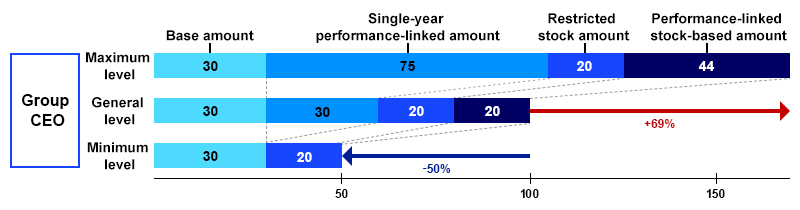
Remuneration for directors (excluding outside directors and directors serving as Audit & Supervisory Committee members) is made up of a base amount, a single-year performance-linked amount (company performance and individual performance) and a stock amount (restricted stock and performance-linked stock-based). In the case of outside directors and directors serving as Audit & Supervisory Committee members, remuneration is in the form of a base amount only. The level of remuneration for outside directors (excluding directors serving as Audit & Supervisory Committee members) shall be set with reference to third-party survey data on executive compensation, taking into account industry characteristics, and the level of remuneration for directors serving as Audit & Supervisory Committee members shall be set using third-party surveys, etc. regarding remuneration of executives in Japanese companies. The Policy for Determining Remuneration of Officers, including these policy and principles, has been decided on by the Board of Directors based on the deliberation of the Remuneration Advisory Committee, the majority of which is made up of outside committee members.
Policy on officer remuneration amounts and how to choose methods for calculating these amounts
Remuneration for directors (excluding outside directors and directors serving as Audit & Supervisory Committee members) is made up of the base amount, the single-year performance-linked amount and the stock amount.
The Company sets Key Performance Indicators of the single-year performance-linked amount so that such remuneration serves as an appropriate incentive in achieving objectives under the medium-term management plan.
Outside directors and directors who are Audit & Supervisory Committee members receive basic remuneration only.
The level of remuneration for outside directors (excluding directors serving as Audit & Supervisory Committee members) shall be set with reference to third-party survey data on executive compensation, taking into account industry characteristics, and the level of remuneration for directors serving as Audit & Supervisory Committee members shall be set using third-party surveys, etc. regarding remuneration of executives in Japanese companies.
| Directors (excluding directors serving as Audit & Supervisory Committee members) | Directors (Audit & Supervisory Committee members) | Remarks | ||
|---|---|---|---|---|
| Inside | Outside | |||
| Base amount |  | | | Remuneration according to duties and responsibilities |
| Single-year performance-linked amount | * | - | - | Linked to the single-year level of achievement of performance indicators |
| Restricted stock amount | | - | - | Set for the purpose of achieving management objectives in the medium-to long-term and sharing interests with shareholders |
| Performance-linked stock-based amount | * | - | - | Linked to the level of achievement of the indicators selected in light of the management objectives as an incentive for enhancing corporate value |
- *Excluding directors who are not in charge of business operations
Diagram of Remuneration (Example : Representative Director, President)
(when key performance indicators achievement is at standard level total remuneration is set as 100)
Key Performance Indicators (KPIs) for Performance-linked Amounts
| Business Perspective | KPI |
|---|---|
| Economic value | Group ROEV |
| Group Value of New Business | |
| Accounting profit | Group Adjusted ROE |
| Group Adjusted Profit | |
| Cost of Capital | Equity·Interest Rate Risk/EV |
| Market Evaluation | Relative TSR |
| Soundness | Economic Solvency Ratio (ESR) |
- *The above are KPIs for the single-year performance-linked amount (company performance) and performance-linked stock-based amount.
- *Adjusted ROE is calculated according to the following formula: Adjusted profit / (Net assets - Goodwill - Unrealized gains / losses on fixed-income assets)
- *Equity·interest rate risk / EV is set as an indicator that has a certain correlation with elements of capital cost that can be reduced through self-help efforts, and is calculated as (equity risk amount + interest rate risk amount) / EV
- * TSR stands for total shareholder return and means shareholders' total return on investment, which is a total of capital gains and income gains.
- *Relative TSR is a comparison with the following 14 companies in total:
5 insurance companies operating in Japan-JAPAN POST INSURANCE, T&D Holdings, Tokio Marine Holdings, MS&AD Insurance Group Holdings, and Sompo Holdings; and
9 companies that operate life insurance business globally-Aflac, AXA, Manulife, MetLife, and Prudential (US), AIA, Prudential (UK), Allianz, Zurich.
Total Remuneration Details for Fiscal 2025
| Total remuneration (Millions of yen) | Remuneration components (Millions of yen) | Number of board members | ||||||
|---|---|---|---|---|---|---|---|---|
| Basic remuneration | Single-year performance-linked amount | Non-monetary amount (stock amount) | Others | |||||
| Company performance amount | Individual performance amount | Restricted stock | Performance-linked stock | |||||
| Directors (excluding outside directors and - directors serving as Audit & Supervisory Committee members) | 639 | 279 | 98 | 19 | 87 | 154 | 0 | 6 |
| Directors serving as Office of the Audit & Supervisory Committee members (excluding outside directors) | 109 | 109 | - | - | - | - | 0 | 2 |
| Outside directors (excluding directors serving as Office of the Audit & Supervisory Committee members) | 82 | 82 | - | - | - | - | - | 4 |
| Outside directors serving as Audit & Supervisory Committee members | 80 | 80 | - | - | - | - | - | 4 |
Total consolidated remuneration for each officer
| Name | Total consolidated remuneration (unit: million yen) | Classification of Directors |
|---|---|---|
| Tetsuya Kikuta | 330 | Director |
| Toshiaki Sumino | 169 | Director |
| Hitoshi Yamaguchi | 123 | Director |
- *Only the director whose total consolidated remuneration exceeds 100 million yen is listed.
Independence Standards for Outside Directors
As part of its approach to strengthening corporate governance, Daiichi Life has established its own standards to determine the independence of its outside directors.
From an independence perspective, the maximum tenure for outside directors (including those serving as Audit and Supervisory Committee members) shall be eight (8) years.