
Compliance
The Daiichi Life Group understands that complying with laws and regulations, its Articles of Incorporation, social standards, and rules in the market is the basis for conducting business activities. To fulfill its social responsibilities and public mission, the Company is developing systems to promote compliance in the group’s operations.
Policies and Regulations
Our Basic Internal Control Policy for the Daiichi Life Group includes basic matters concerning the development and management of a group compliance system. Under this basic policy, matters such as the basic approach to the promotion of group compliance are outlined in the Basic Compliance Policy for the Daiichi Life Group, and matters concerning management related to compliance with the prevention of corruption, including unfair transactions in violation of anti-monopoly laws, such as abuse of a dominant position and anti-competitive behavior, insider trading, money laundering, and bribery are outlined in the Compliance Regulations for the Daiichi Life Group. In addition, the basic approach to the protection of information assets are outlined in the Information Assets Protection and Management Basic Policy for the Daiichi Life Group, and other management practices are outlined in the Information Assets Protection and Management Regulations for the Daiichi Life Group. These policies and regulations have been enacted and revised through prescribed procedures, and the details are reported to the management of the Board of Directors and the Management Council.
Information Assets Protection and Management Policy for the Daiichi Life Group
Basic Concept
In light of the importance of information assets (e.g. customer information, shareholders information, material facts, and unique information) and the social responsibility of the Group which owns the information, the Company shall protect and manage information assets appropriately, while complying with applicable laws and regulations including the Act on the Protection of Personal Information.
Implementation of PMIA
The Company shall implement and manage the system for PMIA as follows :
- 1PMIA System
The Legal and Compliance Unit (hereinafter known as the “Responsible Unit”) shall supervise the PMIA of the Group.
The Responsible Unit shall properly understand the status of the Group’s PMIA, and report it to the Board of Directors or equivalent organization. - 2Rules and Regulations
The Responsible Unit shall establish and revise the rules and regulations for PMIA.
- 3Sharing the Policy with Group Companies
The Responsible Unit shall provide this policy to the Group companies and have each Group company establish its own basic PMIA policies conforming to its business characteristics. The Responsible Unit shall collect necessary information to monitor the PMIA of the Group companies and take appropriate measures if necessary.
Risk-based compliance management
For the purpose of ensuring the execution of duties by directors, executive officers and employees in accordance with applicable laws and regulations and the Articles of Incorporation and accurately grasping important compliance risks and potential conduct risks in accordance with changes in the social environment, the Company has developed an appropriate risk-based management system from a forward-looking perspective.
The Company has put in place a system for the Legal and Compliance Unit to supervise matters concerning Group compliance, and this Unit has developed a system to monitor the advancement of compliance at each company and provide necessary guidance and support by setting challenges which the Group should focus on, as well as reporting problems that occurred at each Group company to the Board of Directors, the President (Group CEO), the Executive Management Board and the Audit & Supervisory Committee, etc. according to their materiality.
In addition, as an organization to discuss important matters concerning the development and promotion of systems relating to Group compliance, the Company has established the Group Compliance Committee chaired by the Group CCpO (Chief Compliance Officer) to be able to practice PDCA mainly among the management.
The establishment and operation of these compliance management frameworks are reviewed and verified through risk-based internal audits conducted by the Internal Audit Unit. Such audits include reviews of Group companies’ initiatives to prevent money laundering and terrorist financing, as well as bribery and corruption.
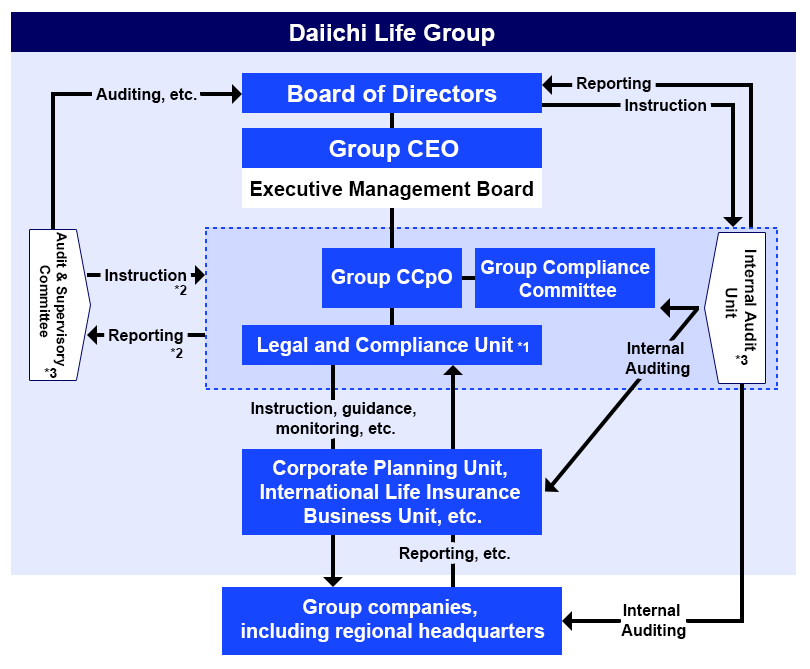
- *1Legal and Compliance Unit coordinates with other units as appropriate.
- *2Dotted frame shows the entities which Audit & Supervisory Committee makes instruction to, and receives reporting from.
- *3Audit & Supervisory Committee and Internal Audit Unit coordinate with each other.
Efforts to improve systems at each Group company
The Legal and Compliance Unit provides guidance and support to improve the compliance system at each Group company and raise their awareness of compliance and enhance their education and training.
In addition, given the risk that related laws and regulations of foreign countries could be applied extraterritorially associated with the global business development of the Group, the Legal and Compliance Unit also works to strengthen systems to prevent money laundering, terrorism financing, corruption, bribery, protect personal information. In order to control such risks, each Group company has established internal policies and rules, and is disseminating them through education and training for employees. In the event of violations by officers and employees, disciplinary actions are taken in accordance with the employment regulations. The results of disciplinary actions are also reflected in employee performance evaluations and compensation.
- 1Anti-Money Laundering / Countering the Financing of Terrorism (AML/CFT)
Daiichi Life Group has established the “Guidelines for the Development of Anti-Money Laundering Framework for Daiichi Life Group”, which set out our fundamental approach to preventing money laundering, terrorist financing, and breaches of economic sanctions. These guidelines define key principles and provide a structured framework to support Group companies in establishing and maintaining effective controls aligned with applicable regulations and international standards.
While not intended for uniform application, the guidelines articulate the minimum expectations and strategic direction of the Group, serving as a common benchmark across all entities. They are designed to promote the autonomous and risk-based development of AML/CFT frameworks tailored to each company’s business model, geographic footprint, and product characteristics. Through this approach, the Group seeks to continuously enhance the effectiveness and consistency of our overall financial crime risk management framework.
<Key Items>
Governance and Policies
- The Group requires each entity to establish and maintain comprehensive AML/CFT policies and procedures, subject to regular review and updates in response to regulatory developments.
- Senior management and the Board of Directors are expected to provide strong oversight and demonstrate clear accountability.
- Clear customer acceptance standards are defined to prevent relationships with sanctioned or otherwise prohibited parties.
Risk Assessment (Risk-Based Approach)
- AML/CFT risks are identified and assessed on a periodic basis, enabling the implementation of targeted and effective mitigation measures.
Customer Due Diligence (CDD/EDD)
- Customer information must be collected and assessed in accordance with applicable laws and regulations, including those with extraterritorial effects. Enhanced due diligence measures are applied to higher-risk relationships, and customer information is subject to ongoing review.
Screening
- Group companies implement robust screening processes at key stages, including customer onboarding and claims/payment processing.
- Ongoing screening of existing customers is conducted to reflect updates to sanctions lists and regulatory requirements.
Transaction Monitoring and Suspicious Transaction Reporting
- Appropriate systems and procedures are established to monitor transactions and identify suspicious activities.
- Where necessary, suspicious transactions are reported in accordance with relevant regulatory requirements.
Risk Management in M&A
- Financial crime risks are assessed as part of pre-acquisition due diligence processes to ensure that potential exposures are identified and mitigated.
Record Keeping
- The scope of records, evidence, and data related to AML/CFT activities is clearly defined, and retention periods are established in line with regulatory requirements.
Monitoring and Testing
- Group companies conduct ongoing monitoring and periodic effectiveness testing of its AML/CFT framework, leveraging a risk-based approach to ensure continuous improvement.
Training
- Directors and employees receive regular training to enhance their understanding of evolving regulatory expectations, including extraterritorial requirements, and to reinforce a strong culture of compliance and ethical conduct.
Incident Management
- Procedures are established to ensure timely and appropriate responses to incidents related to financial crime risks.
- 2Prevention of Bribery and Corruption (ABC)
Daiichi Life Group has established the “Guidelines for the Development of Anti-Bribery Framework for Daiichi Life Group”, which set out our commitment to prevent bribery and corruption. The guidelines clearly prohibit bribery and, in principle, facilitation payments, and provide a structured approach to compliance with applicable laws and regulations.
These guidelines define the Group’s baseline expectations while allowing flexibility in implementation, enabling each entity to develop controls appropriate to its operating environment. This approach supports the consistent strengthening of anti-corruption measures across the Group.
<Key Items>
Governance and Policies
- The Group requires each entity to establish ABC policies and procedures, subject to regular review and updates in response to regulatory developments.
- Senior management and the Board of Directors are expected to provide strong oversight and demonstrate clear accountability.
Risk Assessment (Risk-Based Approach)
- ABC risks are identified and assessed on a periodic basis, enabling the implementation of targeted and effective mitigation measures.
Gifts and Entertainment
- Group companies establish clear rules governing gifts and entertainment provided to public officials and other stakeholders. These rules are designed to ensure that such practices are reasonable, transparent, and defensible under applicable laws, regulations, and social norms.
- Measures are implemented to prevent bribery in transactions with private counterparties, ensuring fair competition and ethical business practices.
Third-Party Risk Management
- Group companies address bribery risks associated with third parties, including vendors, agents, and consultants, through appropriate due diligence and oversight measures.
Risk Management in M&A
- ABC risks are assessed as part of M&A due diligence, including risks associated with target entities and relevant intermediaries.
Monitoring and Testing
- Group companies conduct periodic reviews of expenses, payments, and transactions to detect and prevent improper conduct.
Due Diligence in Hiring
- Appropriate due diligence is conducted during recruitment to mitigate the risk of hiring individuals with elevated corruption risks.
Training
- Directors and employees receive regular training to promote awareness of ABC requirements and foster a strong ethical culture throughout the organization.
Dealing with bribery and corruption cases
- Establish procedures for responding to bribery and corruption cases, including methods for fact-finding, internal and intra-group reporting frameworks, and development of measures to prevent recurrence.
Whistleblowing
- Establish a whistleblowing framework to enable early detection and remediation of misconduct, thereby strengthening the organization’s capability to identify and address potential acts of bribery and corruption.
Disciplinary Actions
- Clearly define responses to bribery and corruption violations and ensure appropriate disciplinary measures are imposed without arbitrary judgment.
Cooperation with Investigations
- Actively cooperate with investigative authorities, including relevant authorities responsible for enforcing extraterritorial laws, and respond proactively to interviews and inquiries. In addition to such cooperation, strengthen internal investigations by conducting independent fact-finding and evidence collection.
Operation of whistleblowing system
We have established an internal whistleblower center where directors, employees (including retirees within one year), etc. of group companies can directly report and consult on compliance-related matters, such as violations of laws and regulations*1. The Company has also established an external contact point (outside law firm*2) that is independent of management. These contact points can be used anonymously.
At the external contact point, an external lawyer receives reports and consultations, manages their content, and determines whether or not to cooperate with the company, taking into account the whistleblower’s intentions and the details of the case. In this way, the external contact point functions as an independent and impartial entity, ensuring the protection of whistleblowers and the effectiveness of the reporting system.
In addition, we have established a system for reporting matters to the Board of Directors, the President (Group CEO), the Management Committee, and the Audit and Supervisory Committee, depending on the severity of the matter.
In addition, in accordance with the Whistleblower Protection Act, we have established internal regulations (internal reporting regulations) to thoroughly ensure privacy and confidentiality by ensuring that legitimate whistleblowers and consultants are not treated disadvantageously for doing so, and that the contents of reports and information learned during investigations are not leaked without a legitimate reason. In addition, we do not tolerate any acts of retaliation, and stipulate that disciplinary action may be taken against those who investigate or treat whistleblowers and consultants disadvantageously. By making these known, we are strengthening the thorough protection of whistleblowers and the establishment of a system.
Additionally, we post information about the contact points and how to use them on posters, manuals, and the company intranet, and regularly hold training sessions to raise awareness among executives and employees of each group company and encourage them to use the hotlines appropriately.
- *1This includes violations of the Insurance Business Law, the Companies Act, the Financial Instruments and Exchange Law, and other laws and regulations, as well as matters related to bribery, corruption, discrimination, harassment, and other human rights issues.
- *2Mori Hamada & Matsumoto
[Results of the Whistleblower Hotline (Daiichi Life Group, Inc. and The Daiichi Life Insurance Company, Limited)]
- FY2025 : 723 cases (Including opinions and suggestions from employees that do not fall under the category of whistleblowing)
- Among the above, cases in which human rights violations such as harassment were recognized and disciplinary action was taken : 4 cases
- *Including opinions and suggestions from employees that do not fall under the category of whistleblowing
Response Flow of the Whistleblower Hotline
In cases where there is a suspicion of violation of laws and regulations, harassment, or other human rights issues, the facts are investigated, and disciplinary action is taken in accordance with the employment regulations if there is any violation.

We accept whistleblowing reports from business partners and clients regarding violations of laws and regulations such as the Insurance Business Act, Companies Act, and Financial Instruments and Exchange Act, as well as bribery, corruption, and human rights violations such as discrimination and harassment by officers and employees of our group.
- *Whistleblowers will not be subjected to Unfavourable treatment. In addition, any Information about whistleblowers and the contents of their reports will be managed strictly in accordance with our company regulations.
1-13-1 Yurakucho, Chiyoda-ku, Tokyo 100-8411
Daiichi Life Group, Inc., Legal and Compliance Unit, “Speak Up Desk”
- Department
Legal and Compliance Unit Incident Management Group
- Person in Charge
Executive Officer in Charge of Legal and Compliance Unit Group Chief Compliance Officer