
Ⅲ. Environmental Leadership
Issues the world is facing
- With the loss of natural capital and biodiversity and the increasing damage caused by natural disasters, decarbonization and realization of a circular economy have become key global issues.
- On a global scale, the increasing demand for energy in developing and emerging countries makes it imperative to shift to sustainable energy sources to mitigate climate change. It is important to support economic growth and social development while minimizing the impact of climate change through international investment, cooperation in climate-related funds, and the development of joint programs.
- Given Japan's low level of energy self-sufficiency, it is necessary to strengthen preparedness for natural disasters caused by climate change and to secure stable and sustainable energy sources.
Our Aspiration
- We recognize that environmental issues such as climate change and biodiversity are pivotal management issues that can have a significant impact on the lives and health of our customers, the operation of our business and the sustainability of society.
- As a global insurance group, we will continue our own efforts to reduce greenhouse gas emissions and strengthen our efforts to reduce emissions in cooperation and collaboration with the companies in which we invest and finance, through proactive engagement, transition finance and impact finance.
- We will also participate in domestic and international initiatives such as GFANZ (Glasgow Financial Alliance for Net Zero) and actively promote global opinion exchange and contribution to rule-making.
Climate Change and Natural Capital Initiatives
Basic Approach
Climate change is having severe impacts on societies and economies worldwide. More than half of the world’s GDP is estimated to be derived from nature and ecosystems, and natural capital is also an essential foundation for the Group’s business activities. The two are also said to be closely related, as heavy rains, floods, and droughts caused by climate change can lead to the degradation of natural capital.
Based on this recognition, Daiichi Life Group, in compliance with the Group's Vision and Group Action Principles for Environmental Initiatives, considers that the conservation of the local environment, climate change countermeasures, global environmental protection, the preservation of natural capital and biodiversity, and the development of the circular economy are its corporate social responsibilities as a member of society, and strives to take environmentally friendly actions throughout its business activities.
In response to such ideas, the Group has defined Environmental Leadership as an important issue in the Medium Term Management Plan, and is committed to strategic responses to environmental challenges, particularly climate change and natural capital. Specifically, we clearly define the environmental issues that our Group should prioritize and are steadily advancing relevant initiatives, such as the establishment, execution, and periodic updates of our Net Zero Transition Plan, as well as information disclosures aligned with the TNFD recommendations and nature-related transition plans.
Environmental Action Policy for the Daiichi Life Group
Basic Concept
As a member of society, Daichi Life Group recognizes its corporate social responsibility to preserve the environment in each region, to protect the global environment, including climate change, to preserve natural capital and biodiversity, and to build a recycling-oriented society. Daiichi Life Group works to preserve the environment on a daily and continuous basis in accordance with the following action guidelines, and continuously improves its efforts to contribute to the sustainable development of society.
- 1Environmental Action in Business Activities
In our business activities, we comply with all laws and regulations related to environmental preservation, and always strive to act with consideration for the impact on the environment. - 2Reduction of the Environmental Impact by Business Activities
We strive to reduce the environmental impact of our business activities by promoting resource conservation, energy conservation, decarbonization, resource recycling and pollution prevention with regard to the consumption of resources and energy and the release of waste and other materials. - 3Promotion of Environmental Awareness Activities
In addition to raising the awareness of executives and employees of environmental issues, we endeavor to promote environmental awareness activities, including donations and support for environmental preservation activities. - 4Enhancement of Information Disclosure and Stakeholder Engagement
We set targets for environmental initiatives and disclose them appropriately and proactively.
We also emphasize engagement with various stakeholders and aim to resolve environmental issues with them.
Governance and Risk Management
Governance/Risk Management Framework
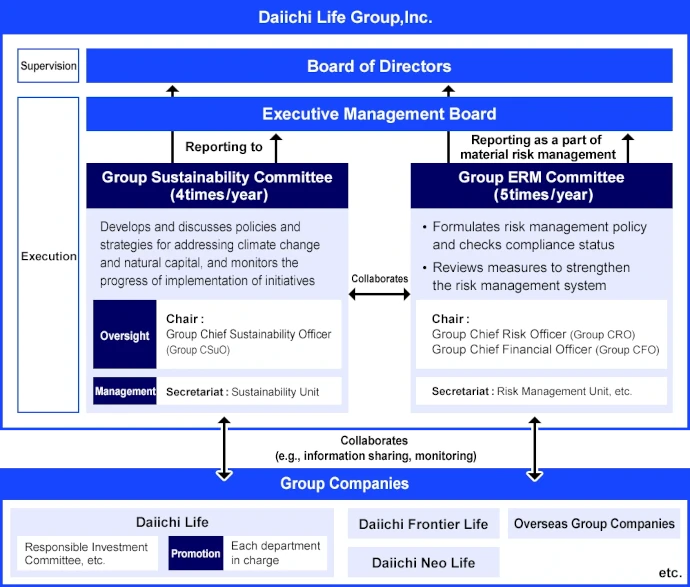
Under the supervision of the Board of Directors and in accordance with its business plan on climate change led by the Executive Management Board, the Group is promoting initiatives related to climate change and natural capital through the Group Sustainability Committee, the Group ERM Committee, and other committees. The status of initiatives is regularly reported to the Executive Management Board and the Board of Directors. By ensuring oversight from the Board of Directors, we have a framework that further strengthens efforts to address climate change and natural capital issues.Alos,sustainability indicators, including an indicator related to progress in reducing CO2 emissions, have been included as part of evaluation criteria of the performance-based stock remuneration for the Group's executives.
For details of the Governance and Risk Management on Climate Change and Natural Capital, please refer to Sustainability Report (P68~78).
Strategy
We remain committed to acting with careful attention to our impact on the environment and natural capital impacts, both as a business operator and as an institutional investor, by concretizing and disclosing our net zero transition plan and recognizing risks and opportunities, while also aligning with international financial initiatives such as GFANZ.
For details of the Strategy on Climate Change and Natural Capital, please refer to Sustainability Report (P79~141).
Metrics and Targets
We established multiple indicators both as a business operator and as an instutional investor.
For details of Metrics and Targets on Climate Change and Natural Capital, please refer to Sustainability Report (P142~145).
For details of the status Climate Change and Natural Capital Initiatives, please refer to Sustainability Report (P62~145).